
Philanthropy lets parents watch which children will rise to the occasion.
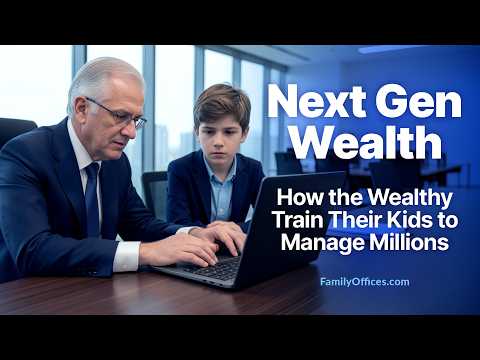
A multi-family office principal on the panel says family philanthropy brings the whole family around the table, lets parents hear which children want to be involved, and shows which children will rise to the occasion before they inherit the for-profit side of the family office. Other panelists discuss using AI and CRM tools, with one noting that real estate runs 5 to 10 years behind other industries on technology. A real estate operator says investors who backed his company in 2002 and 2003 have since handed their family office to their children, and on his most recent deal with them he returned 10 times their money in 18 months. Another panelist's family foundation has run mentoring programs since about 2005, including helping a young man from South Africa become the first Black player on the South African polo team. The closing advice is not financial: don't forget your health, your kids and your family.
- 01Family philanthropy lets parents see which children want to be involved and who will rise to the occasion.
- 02Children who inherit money without understanding the family's assets, such as real estate, put that wealth at risk.
- 03Real estate runs about 5 to 10 years behind other industries on technology, according to one panelist.
- 04Early investors from 2002 and 2003 handed their family office to their children, who kept investing with the same operator.
- 05On a recent deal those investors put in a couple million dollars and earned 10 times their money in 18 months.
- 06One panelist says if you are still raising capital after 10, 15 or 20 years, you are doing something wrong.
[13:37]"We've talked about the communication. Now you can hear what the kids are doing. You can hear find out which kids want to be involved in this. And mom and dad get the opportunity to watch what the kids are doing and responding."
[13:49]"So now if we go back to the family office, uh, which is the for-profit side of the family, they now have the parents have a good idea of which children are going to rise to the occasion."
[14:10]"Because again, if they're going to inherit a whole bunch of money and they don't know what anything about real estate as an example, because so much of that is is what we're talking about, what what's going to happen to that wealth?"
How can philanthropy prepare the next generation?
A multi-family office principal says philanthropy brings the family around the table and lets parents hear which children want to be involved. Parents can then see which children will rise to the occasion on the for-profit side of the family office.
Why is it risky for heirs to inherit assets they don't understand?
The panelist says heirs who inherit a lot of money without understanding assets such as real estate put the wealth at risk. Involving them early helps them learn.
How do long-term investor relationships pass between generations?
A real estate operator says investors who backed him in 2002 and 2003 have handed their family office to their children, who still fund his deals within 24 hours. On a recent deal they earned 10 times their money in 18 months.
Full transcript
3,472 wordsWith the advancement of AI and technology, have you implemented any of the stuff like CRM or data analytics into your practice or into your business that's helped with, you know, communication and and you know, your overall structure? Joe said something when he was speaking about the the human relationship like technology doesn't change um the need for you know human interaction. However, with the advancement of AI and technology, whether it's Google deep mind or chat, you know, GBT or all the different tools out there, have you implemented any of the stuff like CRM or data analytics into your practice or into your business that's helped with, you know, communication and and you know, your overall structure? Yeah, we have.
I mean, I heard I don't know if it was in here today, but at this conference, I heard a few people say that the AI boom is starting to come down a little bit. I I personally don't agree with that. I think we're just now starting to see what AI can do. I think AI is we're not even we haven't even scratched the surface personally.
So, we've got some investments in a couple AI companies that we think are going to change uh the industry, right? We feel very uh confident what they're going to do. Um, we've definitely implemented we've always been I I've always said real estate is about 5 or 10 years behind on the technology side versus like the rest of the rest of the country on different things. So fintech, one thing we love about that world and business SAS is we feel like that's kind of leading the way.
Um, you know, don't get me wrong, there's definitely some great real estate players. We saw Service Titan go IPO, uh, what was it, 9 billion this year, and I think you're going to see a few more of those. Um the markets love the fintech space and they love when you combine the fintech with the real estate space. So that's that's one of our favorite softwares or software on the market.
So we've definitely implemented a lot of different tech. Before CO hit, we were already pretty much remote. Um I don't believe in bringing back the staff into the office. I know Amazon and others feel like you have to. I think the smaller companies you can get away with work from home. Um it's definitely more popular.
Obviously, if recession hits, that's going to be a good reason to bring people back in or lay off, right? So, but from our perspective, you know, we've got employees here in LA, uh one's with me at this show. We've got other guys in Dallas and Florida. So, our our firm, we're pretty much remote nationally, and then we have our inoff meeting for whoever's in Scottsdale.
Okay. But yeah, that's our take on it. Sah Hill, um what would you say? I mean, obviously each family has a unique kind of perspective on the market right now and different strategies that you're utilizing. So, like what would you say is working for you right now that you're taking advantage of, you know, in the market today?
Uh, well, I mean, as far as the public markets goes, I'm I've always been one to kind of ignore that because there's so much speculation built into the pricing that it's hard to see where the actual value ad is. So I I much prefer I mean there are definitely certain kinds of trends that you can you can capitalize on. So for example, right um the all of this talk about bringing back 100% bonus depreciation that's a very very good avenue for places like car washes, places like gas stations to really take advantage of of certain things that could reverse the pressures that were inherent in the market. You've got we're in a in a world of cap rate expansion, but when you bring that back into the equation, at least in places like gas stations, you might see a little bit of compression there.
And and that's a that's a very small um and very specific market shift, but I feel like that's kind of the angle that you need to go in because if if you're looking at the same if you're looking at things the same way as everybody else, you're going to make the same exact mistakes that everybody else makes because people are much more uh it's much more common for someone to make a mistake than to succeed. Uh and you want to look you want to look for success where other people aren't looking for it. Got it. Kip, just throwing the same question back to you.
What strategies in this market are you looking to deploy? And well, I'm going to describe something where you we're just starting to use with some families, and it's it's a little different. Um, it's called impact investing. And the concept with impact investing is not about going out and making money for yourself, so to speak. It's not investing in hotels or or single family or I mean, uh, multif family and so forth.
It's actually a philanthropic program and the idea is and we're actually using this potentially with a uh and I'll describe it. It's a uh up in uh Montana, it's a ranch, if you will, that wants to help uh young ladies who've been trafficked, but they're looking at buying more property. So in this impact impact investing program, what you do is you put money into a DAFF and then what the DAFF does instead of just giving the money away, it actually loans out the money and gets a return on it, but the money also comes back into the DAFF so that you can then recycle those dollars and help more people. So that's a it's a form of investing.
You still get some return on your investment, but you also get a nice tax write off and you're helping the community and and other people. So, that's a program we're looking at right now. Right. Right. Same question you uh so uh we um uh from you know from communications we do have a CRM and communication portal that we developed.
So it's a proprietary uh that's safe to communicate uh for 100% agree with you on the foundation side. We do have our own 51c3 called Legacy of Safety providing technology to those communities who can't really afford to obtain them on their own. And uh everything we do is sort of impact related because if uh uh that's why we actually found everything because uh we live in such a world there's so many school shootings. There's so much uncertainty.
I mean kids are you like I have two children and we're worried about them. Uh and uh if we can do anything to help to have a safer place or safer safety for our families, for our children, that's kind of I feel the impact that our our office is creating. Okay, I can see you down there. I want to ask you the same question.
So, our our strategy is pretty simple. We uh we like to develop a few deep long-term relationships that turn into several investments. Uh I I think it was Michael who was on the stage just before us who was talking about getting slapped around with all kinds of investment ideas, you know, pitching. Uh we don't respond well to that either.
What we do respond well to is a long-term relationship, get to know them, understand them better, and that usually turns into really good opportunities. We typically look for off-market independent kind of quiet deals that not a lot of people know about and a few and then we have friends that we'll call and syndicate with other family offices and that turns into a really good situation. So, it's pretty simple. It's relationship building that turn into uh lots of good opportunities down the road.
Can I piggy back off that? Yeah. Yeah, go for it. I absolutely agree. Um, we had an event in Arizona not too long ago and it was a small group of individuals trying to raise capital and and I said the same thing. I said, "If you're still raising capital after 10, 15, 20 years, you're doing something wrong."
Uh, you know, we work with a small group of family offices. They trust a handful of people. We trust a small group of people. Um, I've loved everything he, you know, you've said on this panel. Actually, I'd love to get some wisdom from you cuz my kids, I've been telling them we're broke all these years. It's not working anymore.
They're in high school now. So, uh, at some point I think they're going to figure it out. Uh, I think my oldest already has. But, um, you work with good people and and you do business the right way. If you're here raising capital, it shouldn't be about you. It should be about what you could do for the family office.
It should you should flip it. And that's the way I always looked at it. When I was young, I said, "Hey, let me work hard for you. Let me prove I'm a good guy and I could do a good job for you." And and I could tell you now fast forward 22 years later that one of the individuals that invested in my company back in 2002 2003 uh every time I've called this family office he's retired it's his kids now that have taken over uh and now we're a family office so we actually GP deals together but uh and the last deal I did it uh before BFA he they put in a couple million dollars we 10x their money in 18 months so every time we call this individual Tony within I'm talking 24 hours you get a response back it's funded well just like how Kip is talking about the daff and recycling the money back in you're recycling the money from your LPs from great relationships and investments yep Julie what for you same question any specific strategies that uh I think I think identifying secular trends early and then finding top desile fund managers in that space and developing relationship with them is smart uh I think for most part we're more long-term interested.
If you're talking about more micro identifying say end of last year the pending volatility was a good you know sense we kind of sensed that was coming and uh I think for the most part and we've moved away from real estate for the time being just with the prices being high as they are and then also thinking you know when would be the right way right place to get back in because when you're doing development projects there's usually several years before that comes to fruition. So you're trying to read the tea leaves and also see where everybody else is. I think moving to the open space is not a bad idea and really sticking to those general rules of thumb of you know greed and fear right that we all sort of live by. Yeah.
So if you were to um this is a question a lot of uh guests ask but just the biggest kind of takeaways from you know the topics that we just talked about. Is there anything that you just open to anyone who wants to answer here that um any lessons um or observations you want want to share with the audience? Um well just to sort of chain it all together. Uh there is certainly I mean if you're familiar with stoicism for example you'll you'll be very familiar with the phrase the obstacle is the way.
Uh and I I do tr truly find that that some of the best places to go are places where you can flip everything on its head. And also at the end of the day have everybody better off do some impact investing. So for example, if you go into places like uh universities, cities, small cities uh or other organizations, especially in other countries, you'll find that a lot of their critical infrastructure, water fountains, tanks, solar panels or or other kinds of energy or or other kinds of infrastructure like that is often not owned, but rather rented. And if you can find a way to, you know, go into their P&L, see what they're renting or leasing and and they don't have an ownership stake in, that's incredibly valuable and missionritical.
You find a way, you can find a way to structure it so that uh they come in with uh they come in paying less than they were initially. You end up getting a little bit of a kickback from that and everybody has safer and cleaner access to say portable drinking water. Um, a and you've now turned something that's been a liability on their balance sheet into something that not only on their P&L, you know, shows profits, but also pro probably enables them to uh to be more secure in their mission and everybody is happy. Great.
Natalie, you want to anyone want to add anything or Well, I I think just kind of addressing everybody because uh everybody in this room, we are we have more ways to contribute to society, to help other people, to make a world a better place. And I think we also just need to ask ourselves, okay, it's not about me. What can I do? List a little bit one day at a time to help a stranger to help, you know, with impact investing whether anything advisoring, getting some advisory boards in universities.
I I do that in US of Maryland. Um I mean I also uh wrote a book unbreakable guide to troubles and full of life just to as a guide to help people overcome challenges because people are faced with so much with how fast economy is growing what's going in the world. So I think we should be the role models for so many people to look up to and to focus that it's okay you know we all been through challenges. I'm sure there's not one person here who did not have a something bad happened to them and they overcome.
So, I think that's what we must ch away with for me. Yeah, it's only February. Y uh yeah, we're are really big fans of philanthropy and for obvious the reasons we've been talking about here uh cuz the value obviously of helping other people, but the value of what it can do to your family is incredible. So, and I use this generically.
So, let's assume we do have a family foundation. Again, it could be a donor advice fund. A foundation is a business, right? It has financial statements. It has tax returns. It's got investments to manage.
It's got to do research as to what causes do you want to fund? And it's got to have a management team. Well, in today's world, the the current generation is excited about doing social things. So now you have an opportunity to bring the whole family around the table and to open up. We've talked about the communication. Now you can hear what the kids are doing.
You can hear find out which kids want to be involved in this. And mom and dad get the opportunity to watch what the kids are doing and responding. So now if we go back to the family office, uh, which is the for-profit side of the family, they now have the parents have a good idea of which children are going to rise to the occasion. But the point is, you're creating a platform of real life experiences teaching the the this next generation what's the difference between a mutual fund and a checking account?
Because again, if they're going to inherit a whole bunch of money and they don't know what anything about real estate as an example, because so much of that is is what we're talking about, what what's going to happen to that wealth? So, we want to bring them into that process and philanthropy is just a great way to do it. And they can't fight over the money because they're not going to get it anyhow. Uh Robert, could could I point something out?
Go for it. Uh so, we have a legacy in the mentoring space going back to about 2005. Uh we've done mentoring projects with Julian Schnobble and an autistic artistian. We worked with a young uh person of color in Zulu nation in South Africa got him to be the first black person playing for the South African polo team.
Uh we've done medical projects in East Africa, the Harvard School of Public Health. So it's kind of a long list of project that that we've done and we've gone through a number of iterations published at best practices and more recently we did an AI type project where we interviewed people on the telephone in a 30inut intake automated interview process to find out about mentoring competencies and also to analyze people's motivations and so forth. Worked with a company called Million Ways. Martin, I can't remember his last name, uh, calls me up one day, he says, you know, we've come up with something that I'm not sure I want to share with you.
And I said, well, you've got to tell me what that is. He says, well, you know, we've done about 50 of these interviews and and it turns out that the biggest motivation for people to be mentors is power. And so, we were a little disappointed by that. But I just want to point out that it's created a little bit of a jaded uh impact upon me when I think about impact investing and philanthropy and so forth because yes, I think many people do want to give back but not everybody.
Okay. And I think especially in this space once there's money in the room, you know, there's one guy and then there's 15 around it. So just as we sort of remain with a sober perspective about this whole thing. So just wanted to share that. Yeah. Danny to uh you know go back to what I was saying earlier.
We're so close with some of our investors and family offices. One one of the uh greatest things I think we did when we sold our last company, we set up our own family foundation, but we're so tight with some of the family office is that sometimes we'll just be on a golf course and uh most recently the guy had a passion for a new church addition to the Christian school that he helped found and and the two three other family offices all have their own family foundations. We all kind of chipped in and helped build out that auditorium. So, um, again, you work with good people that have the same values and vision and focus.
For us, it's not I've always said I I don't want to be the richest guy in the cemetery. I mean, you're taking nothing with you. So, uh, to to sit, you know, complete what you're saying. But once you find that good group of investors and family offices, we're so aligned even on the uh Christian, you know, um focus of what we want to do before we pass that uh we work not just on the investment side, but also on the giving back side.
So, it's pretty we're we're blessed to be where we're at. But absolutely, you have to that's a part my wife loves. She says, "You make the money in the family office. I'll take care of the donations." So, in the 15 seconds we have left, I will tell you that my advice has nothing to do with financial. Uh, you know, I'm I'm at the point in my life where I look back a lot now and the thing that I I'm super happy that I did was I kept balance in my life.
So, if you're chasing your career and your dreams, don't forget balance. Don't forget your health, your kids, your family. You know what what matters most at the end of the day after all this is all of those things. And if you're pursuing this and not bringing that along with you, then it's a big mistake. Thanks, guys. Great panel.
More from this playbook
We do 16 of these live a year.
Apply for access